If you are weighing All-on-X vs individual dental implants in Lowell, the key question is how many teeth need replacement and what kind of restoration can be planned for your mouth. These approaches serve different needs: individual implants replace separate teeth, while All-on-X is a fixed full-arch approach for replacing a full row of teeth. A dental examination and imaging help determine which options may be appropriate for you.

At Lowell Family Dental Practice, we encourage patients to understand the purpose and tradeoffs of each option before making a decision. The right plan depends on your oral health, the condition and number of teeth involved, your goals, and clinical findings. This overview can help you prepare for a conversation with a dental professional; it cannot determine which treatment is right for you.
What is the difference between All-on-X and individual dental implants?
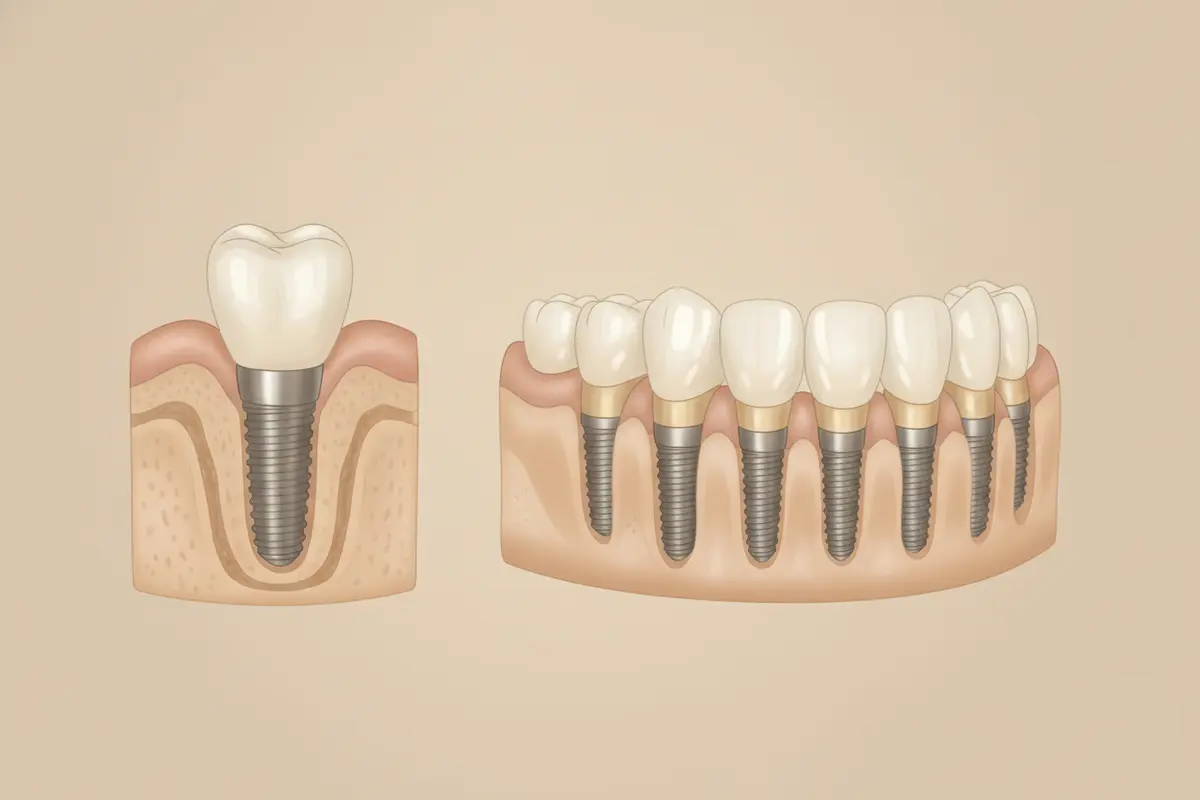
An individual dental implant replaces a missing tooth with an implant-supported restoration for that specific space. The implant is placed in the jaw, and after assessment and healing, a replacement tooth is attached. When several teeth are missing in separate locations, a treatment plan may include more than one individual implant, depending on the situation.
All-on-X refers to a fixed full-arch restoration supported by a planned number of implants. Rather than replacing each tooth with its own implant, the approach uses implants to support a connected prosthesis for an entire upper or lower arch. The “X” describes that the number of implants is determined by the treatment plan; it is not a promise that every patient receives the same number.
Both approaches use dental implants, but they are not interchangeable labels for the same treatment. One is usually considered for one or a small number of separate missing teeth; the other is designed around a full arch. A review of dental implant care can provide background on the practice’s implant services, while a consultation addresses your personal situation.
| Consideration | Individual implants | All-on-X |
|---|---|---|
| Typical treatment scope | One or more separate missing teeth | A full upper or lower arch |
| Restoration design | Separate implant-supported replacement teeth | A connected fixed full-arch prosthesis supported by implants |
| Planning focus | Each missing-tooth space and surrounding teeth | Arch-wide function, implant positions, and prosthesis design |
| Suitability | Depends on the site, bone and gum health, and overall plan | Depends on full-arch needs, examination, imaging, and overall health |
| Maintenance | Daily care and professional follow-up for each restoration | Daily cleaning around the prosthesis and regular professional follow-up |
This comparison is a starting point, not a treatment recommendation. The materials, number of implants, sequence of visits, and timing depend on a clinician’s assessment. Ask what is included in the proposed plan and what alternatives apply to you.
When might individual dental implants be considered?
When a single tooth is missing, an individual implant may be one option to discuss. It can replace a tooth without using the neighboring teeth as supports, unlike some other tooth-replacement approaches. Whether this is suitable depends on factors such as the space, the condition of nearby teeth, gum health, available bone, and your overall dental needs.
For more than one missing tooth, separate implants may be considered in some cases. The number and position of implants are not automatically the same as the number of teeth being replaced. A dentist evaluates how the planned restorations will work together and whether another approach would better address the gaps.
Some patients have teeth that are damaged or have a poor outlook rather than already missing. The clinician must assess those teeth before discussing whether to preserve them, treat them, or consider replacement. Do not assume a tooth needs removal simply because an implant is being discussed. A conversation about missing teeth and replacement options can help you frame your concerns, but your examination guides the plan.
When might an All-on-X approach be discussed?
All-on-X is a full-arch option to discuss when a patient needs a fixed replacement for most or all teeth in an arch. It may be considered in different clinical circumstances, including extensive tooth loss or a full-arch plan involving teeth that cannot be maintained. Only a qualified clinician who has examined you can determine whether it is appropriate.
Full-arch planning considers more than the visible teeth. The clinician evaluates the gums, jawbone, bite, existing restorations, medical history, and the patient’s ability to maintain the prosthesis. A CT scan may be used as part of implant planning when clinically indicated; the information helps the treating team assess anatomy and plan implant placement. Lowell Family Dental Practice identifies modern CT scan technology as part of its implant-focused positioning, but the exact diagnostic process is determined for each patient.
Patients may also want to compare a fixed full-arch option with removable dentures or other restorative choices. The best comparison is not simply “more teeth versus fewer implants.” It is about how each option fits the patient’s anatomy, goals, hygiene needs, comfort, and expectations. See the practice’s information about dentures as one point of comparison, then ask a clinician to explain which alternatives are relevant in your case.
How does the choice affect treatment planning?
The broad distinction is the scope of the restoration. An individual implant plan focuses on a specific missing-tooth site, while an All-on-X plan coordinates an entire arch. That changes the questions the clinician needs to answer and the way the restoration is designed. It does not mean one plan is inherently simpler, faster, or better for every patient.
Assessment and imaging
A consultation generally begins with a discussion of your concerns, health history, and goals, followed by an oral examination. The clinician considers the teeth, gums, bite, and available bone. Imaging may be recommended to assess anatomy and support planning. Bring a list of medicines and relevant health information, and mention past dental treatment or concerns that affect your care.
Restoration and sequence
Ask what the proposed restoration will look like and how it will function, which steps are planned, and what milestones affect timing. The sequence can vary with clinical findings and individual healing. Avoid relying on generalized promises about a specific schedule or number of visits: those details must come from the clinician’s plan for you.
Cost and payment discussion
Costs depend on the treatment plan and what it includes. A useful estimate should explain the proposed procedure, restoration, imaging or other services, and any additional treatment that may be needed. Ask how fees are presented, what could change the estimate, and whether financing is available. Lowell Family Dental Practice notes that third-party financing is available through Proceed Finance and CareCredit; patients should confirm current terms, eligibility, and the services covered directly with the practice and financing provider. You can review the practice’s financing information before asking questions.
What are the tradeoffs to consider?
Individual implants can be a focused option when only one or a few teeth need replacement. If multiple spaces are involved, the overall plan may involve several restorations and separate sites to assess and maintain. An implant in one location does not automatically resolve problems in other teeth or change the health of the rest of the mouth.
All-on-X addresses a full arch as a connected restoration. That can make the plan appropriate to discuss for extensive tooth loss, but it also means the patient is planning for a full-arch prosthesis, not a single replacement tooth. Cleaning under and around the restoration is important, and ongoing professional checks are part of caring for implant-supported teeth. The plan should include clear instructions for daily care and follow-up.
Neither option can be evaluated on a diagram alone. The same person may have different needs in the upper and lower arches, and a treatment plan may need to address other oral health conditions first. If you are uncertain, ask the clinician to explain the alternatives and the reasons for recommending one plan over another. The practice’s dental implant information is another place to begin your research.
Think about the teeth that may remain
A comparison should account for teeth that are still present, not only the gaps you notice. Some teeth may be healthy and maintainable; others may need evaluation or treatment. Ask how the proposed plan affects each tooth and whether preserving a tooth is a reasonable alternative. If a recommendation involves removing teeth, ask which findings support that step and whether a second opinion would help you feel confident. A treatment plan should make clear what is known, what remains uncertain, and what would prompt a change in approach.
Consider daily habits and support
Think honestly about the care routine you can maintain. Any implant-supported restoration needs regular cleaning and dental follow-up, but the shape and design affect how you reach different areas. Ask the team to show you how to clean the proposed restoration and whether you will need special brushes or other tools. If dexterity, mobility, or a strong gag reflex affects home care, mention it during planning. These practical details are part of choosing a workable option, not a minor concern.
Clarify what “fixed” means
Patients sometimes use “fixed” to mean that a restoration feels secure, while a clinician may use it to describe a prosthesis attached to implants rather than something the patient removes at home. Ask how the specific restoration is secured, whether it can be removed by the dental team for maintenance, and what to do if it feels loose or uncomfortable. Confirm what is included in the proposed treatment and what would be handled in a separate visit. Clear definitions reduce surprises when you compare plans.
Compare the full plan, not a headline
When reviewing estimates, compare equivalent details. One plan may include different diagnostic or restorative steps than another, so a total figure without an itemized explanation can be difficult to interpret. Ask what is included, what is provisional, and how the practice handles changes if examination findings differ from expectations. You can also ask whether treatment can be staged and what the implications would be. These are questions for the treating team, because the answer depends on your clinical needs and the practice’s written plan.
How do you compare options at a consultation?
Come prepared to describe what matters most to you: replacing a particular tooth, restoring a full arch, comfort, appearance, ease of cleaning, or understanding the sequence and finances. Then ask for a recommendation grounded in the examination and imaging rather than a generic comparison. These questions can make the discussion more useful:
- How many teeth or areas need treatment, and which teeth may be preserved?
- Is the proposed plan for one or more separate teeth, a full arch, or both?
- What findings from my examination and imaging support this recommendation?
- What other options are reasonable, including non-implant alternatives?
- What steps are involved, and what could change the expected timing?
- What will the final restoration be, and how do I clean and maintain it?
- What is included in the written estimate, and which costs could be additional?
- What follow-up visits and professional maintenance should I expect?
If you have a medical condition or take medicines that may affect dental care or healing, tell the clinician. Do not stop or change medication without advice from the prescribing professional. General oral-health resources from the American Dental Association can help with background reading, but they do not replace individualized diagnosis or treatment planning.
How should you think about recovery and long-term care?
Recovery and follow-up vary by patient and procedure. Your clinician should explain what to expect after the planned treatment, how to care for the area, which symptoms require a call, and when follow-up is needed. If something feels wrong or you have a concern after treatment, contact the dental team rather than relying on a general online timeline.
Implant-supported teeth need ongoing care. Brush and clean around the restoration as instructed, attend recommended checkups, and report changes such as discomfort, looseness, swelling, or difficulty cleaning. A full-arch restoration may have specific cleaning instructions, so ask for a demonstration and the tools that suit your design. For separate implants, make sure you understand how to clean each site and how the surrounding teeth and gums will be monitored.
Long-term maintenance is not an optional detail to decide after treatment. Include it in the comparison from the start. Ask who will monitor the implants and restoration, what routine visits involve, and whom to contact if a repair or adjustment is needed.
Frequently asked questions
Is All-on-X the same as getting an implant for every tooth?
No. All-on-X is a full-arch restoration supported by a planned number of implants; it is not necessarily one implant for every replacement tooth. The number and placement depend on the clinician’s assessment and design.
Can I choose individual implants if I am missing several teeth?
Possibly, but the appropriate plan depends on the position and condition of the missing teeth, surrounding tissues, bite, and your goals. A clinician can explain whether separate implants, a connected restoration, or another option makes sense for your situation.
Does All-on-X always take less time?
No single timeline applies to everyone. Treatment steps and healing vary according to the clinical plan and individual circumstances. Ask your clinician to describe your own sequence and what factors could affect it.
Will insurance or financing cover my treatment?
Coverage and financing eligibility vary. Ask for a written treatment estimate and contact your insurer or financing provider to confirm terms. Lowell Family Dental Practice lists Proceed Finance and CareCredit as available third-party financing options; availability and terms should be verified directly.
How do I know which approach is right for me?
You cannot determine that from the name of the procedure alone. An examination, relevant imaging, and a discussion of your health and preferences help the dental team assess options and explain a recommendation.
Plan a conversation about your options
All-on-X and individual dental implants address different treatment needs, so the most useful next step is a personalized evaluation rather than choosing by terminology alone. Contact Lowell Family Dental Practice to discuss your questions, review the relevant findings, and understand which options may fit your goals.
Dr. Iham Gammas, DMD, DABOI, is the author of this patient education article.
Written by
Dr. Iham Gammas, DMDBoard-Certified Implant Dentist & Founder, Lowell Family Dental Practice. Fellow & Master of ICOI and IADI. Associate Fellow of AAID.