Dental Crown vs Filling: Which Repair Does Your Tooth Need?
A dental crown and a filling both repair damaged teeth, but they solve different problems. A filling replaces a small area lost to decay, while a crown covers and supports a tooth that has extensive decay, a crack, or too little healthy structure for a filling. The safest choice depends on an exam, dental X-rays, your bite, and how much strong tooth remains.
Schedule an exam with Lowell Family Dental Practice to find the right repair for your tooth.
Understanding the differences can help you have a more useful conversation with your dentist. It can also explain why the least extensive treatment is not always the best long-term treatment. The goal is not simply to close a cavity. It is to remove disease, restore comfortable function, and protect as much of your natural tooth as possible.
Dental crown vs filling: the key difference
The key difference is coverage: a filling repairs a limited area inside a tooth, while a crown covers the visible portion of a weakened tooth to reinforce it from the outside.
How a filling repairs a tooth
A dentist uses a filling after removing a small or moderate area of decay. The filling material replaces the missing structure, seals the prepared space, and restores the tooth’s shape. Tooth-colored material can be matched to surrounding enamel, making it a discreet option in many situations.
A filling works best when enough healthy enamel and dentin remain around it to withstand chewing. It is a conservative repair because only the damaged area and the structure needed to prepare it are removed. In many cases, the dentist can complete the treatment in one visit.
How a crown protects a tooth
A crown is a custom restoration shaped like the visible part of a tooth. It covers the prepared tooth and helps distribute biting pressure across the restoration. A dentist may recommend one when decay, a large old filling, a fracture, or previous treatment has left the tooth too weak for another filling.
A crown does not make a tooth immune to future problems. The natural tooth beneath it still needs daily cleaning, and decay can develop near the crown’s edge. However, when correctly selected and maintained, a crown can protect a tooth that otherwise has a high risk of breaking.
| Feature | Dental filling | Dental crown |
|---|---|---|
| Best suited for | Small or moderate, contained decay | Extensive decay, cracks, or a weakened tooth |
| Coverage | Replaces a damaged area | Covers the visible tooth |
| Primary purpose | Seal and restore a limited defect | Reinforce and protect remaining structure |
| Typical process | Often completed in one visit | Often involves preparation and a custom restoration |
| Decision factor | Enough strong tooth remains | Remaining tooth needs broader support |
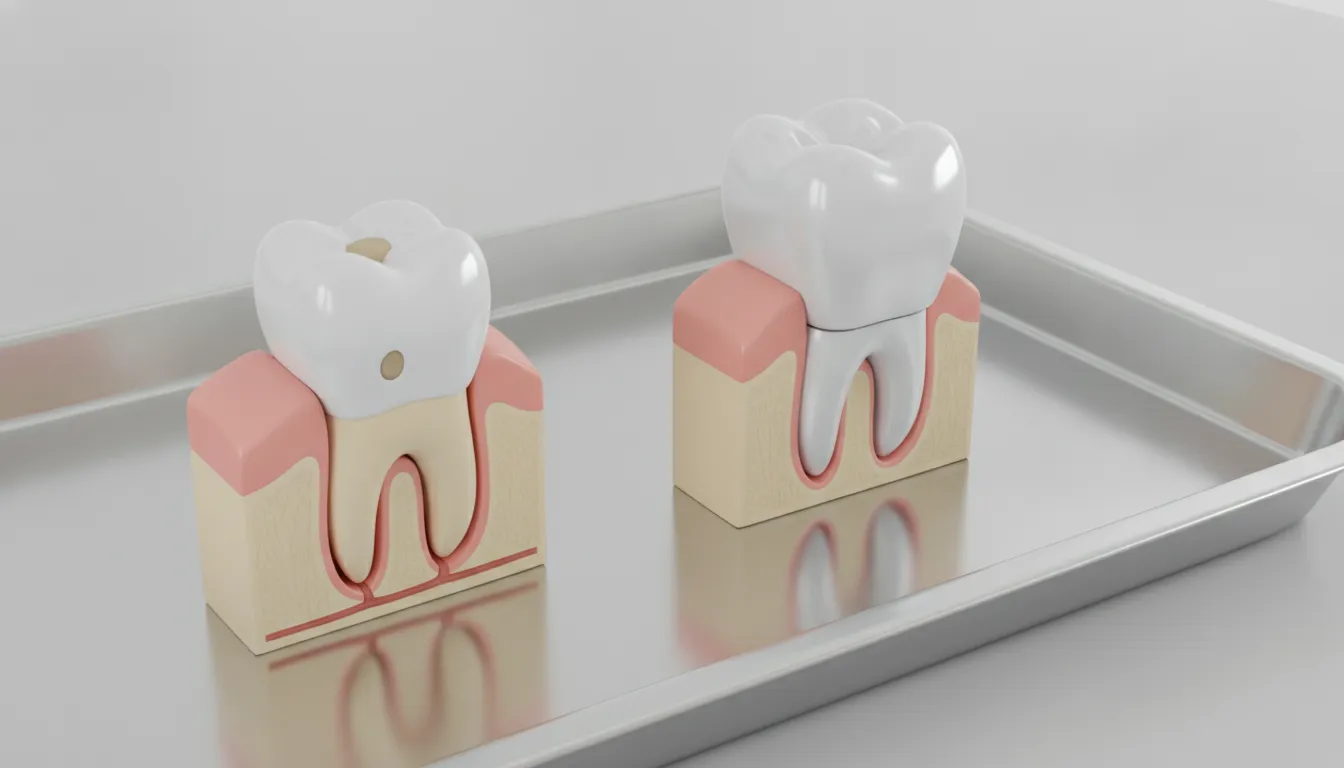
What does a dental filling fix?
A filling fixes a contained area of tooth decay or minor damage when the surrounding tooth is still strong enough to support the repair.
Small and moderate cavities
Cavities begin when acids produced by oral bacteria weaken enamel. If decay is found before it spreads widely, the dentist can remove the affected tissue and restore the space with a filling. According to the CDC, about one in four adults ages 20 to 64 has at least one untreated cavity. Regular exams can find decay before symptoms or major structural loss develops.
After numbing the area, the dentist removes decay and prepares the space. The filling is then placed, shaped, and adjusted so the bite feels natural. Patients may notice temporary sensitivity afterward, but a persistent high bite, worsening pain, or swelling should be reported.
Minor chips and worn areas
Depending on their location and cause, small chips or worn areas may also be repaired with tooth-colored filling material. The dentist first determines why the damage occurred. A repair may fail early if an underlying issue, such as grinding or an uneven bite, is not addressed.
A filling is most predictable when it is surrounded by dependable tooth structure. If a defect is too wide, the remaining walls may flex or fracture under chewing pressure. In that situation, adding more filling material may not provide the support the tooth needs.
When a filling may not be enough
A dentist may advise against a filling when decay extends across several surfaces, a crack weakens the tooth, or a large existing filling has left only thin walls. Symptoms alone cannot determine the right restoration. A small painful cavity and a large painless cavity are both possible, which is why an examination and imaging matter.
If you want to understand other routine and restorative options, explore the practice’s complete dental services. Choosing the right level of repair now can reduce the chance that the tooth needs more complex care later.
What does a dental crown fix?
A crown fixes and protects a tooth that has lost substantial strength, helping it tolerate normal biting forces when a filling would be unreliable.
Extensive decay or a failing large filling
When a cavity is extensive, removing the decay can leave too little healthy structure to hold a durable filling. The same concern can arise when an older, large filling breaks or decay develops around it. A crown surrounds the weakened portion instead of relying only on the internal space for support.
The dentist must still remove decay before placing the restoration. A crown cannot simply cover active disease. The finished crown is designed to restore the tooth’s contour and contact with nearby teeth while allowing comfortable chewing.
Cracked, broken, or heavily worn teeth
Some cracks cause sharp pain when biting or when pressure is released. Others produce few symptoms. A crown can hold parts of a restorable cracked tooth together and reduce stress on vulnerable areas. Whether a cracked tooth can be saved depends on the crack’s depth and location; a crown cannot save every fracture.
Teeth can also become shorter or weaker through wear. Before recommending a crown, the dentist looks for the cause and considers the entire bite. Treating the cause helps protect both the restoration and other teeth.
Teeth that have received root canal treatment
A tooth that has undergone root canal treatment may need additional protection, particularly if it is a back tooth or has lost significant structure. The recommendation depends on the tooth, the amount of remaining structure, and the forces it experiences. The crown’s role is to restore function and lower the risk of structural failure, not to treat the infection itself.
Patients can read more about how dental crowns protect damaged teeth. If a tooth cannot be predictably restored, the dentist may discuss alternatives, including a dental implant, only after reviewing the individual situation.
How does a dentist decide between a crown and filling?
A dentist chooses between a crown and filling by assessing the amount and quality of remaining tooth, the extent of decay or cracking, the tooth’s location, and the pressure it must handle.
Amount of healthy tooth remaining
The most important question is not simply how large the visible hole looks. Decay can spread beneath enamel, and an old restoration can hide weak areas. The dentist examines the tooth and uses appropriate X-rays to understand the depth and location of damage. If solid walls surround a contained defect, a filling may be appropriate. If the remaining walls are thin or undermined, broader coverage may be safer.
Cracks, bite pressure, and tooth location
Back teeth generally absorb stronger chewing forces than front teeth. Grinding, clenching, and an uneven bite can place additional stress on any restoration. The dentist checks for crack lines, movement, wear patterns, and pain on biting. A crown may be recommended when coverage can reduce the risk of a weakened tooth splitting.
A crown is not automatically better because it offers more coverage. It requires preparation of the tooth and must have a clear clinical reason. Likewise, a filling is not automatically better because it is less extensive. The best repair is the most conservative option that can predictably protect the tooth.
Existing treatment and overall oral health
Previous fillings, root canal treatment, gum health, and decay risk can all affect the decision. The dentist also considers whether the tooth can be kept clean and whether there is enough sound structure to support a restoration. If the outlook is uncertain, ask what the dentist sees, what each option protects against, and what could happen if treatment is delayed.
What to expect during restorative treatment
Both treatments begin with an exam and removal of damaged tissue, but a filling is placed into a prepared area while a crown is custom-made to cover a prepared tooth.
Before treatment
Your dentist reviews symptoms, examines the tooth, and takes any necessary images. This is the time to share changes in your health, medications, allergies, or dental anxiety. The team can explain the recommendation, expected visits, alternatives, and aftercare before treatment begins. New patients can review the practice’s new patient information before an appointment.
During a filling appointment
The area is numbed, decay is removed, and the prepared space is cleaned. The dentist places and shapes the filling, then checks how the upper and lower teeth meet. The exact steps vary with the filling material and location. Before leaving, patients should understand when they can eat and what sensations warrant a call.
During crown treatment
For a crown, the dentist removes decay and shapes the tooth so the restoration can fit securely. An impression or scan records the prepared tooth and bite. Depending on the treatment process, a temporary crown may protect the tooth while the final restoration is made. At placement, the dentist checks fit, contacts, appearance, and bite before securing it.
After either restoration
Mild, short-term sensitivity can occur, but symptoms should improve rather than worsen. Contact the office if the bite feels uneven, the restoration feels loose, or pain and swelling develop. Avoid using teeth to open packages or bite very hard objects, since those habits can damage both natural teeth and restorations.
Cost, longevity, and care considerations
Cost and lifespan vary by tooth, material, bite, home care, and insurance, so the best value is the restoration that predictably meets the tooth’s clinical needs.
Comparing cost without guessing
A filling is generally less extensive than a crown, while a crown requires a custom restoration and a broader treatment process. However, no responsible comparison can give an accurate personal total without an exam and benefit review. The office can explain the proposed treatment and help you understand what questions to ask your insurance provider.
Choosing a filling only because it appears simpler can be poor value if the tooth lacks enough support and the repair fails. Choosing a crown without a clinical need would also be unnecessarily extensive. Ask about the expected outcome, alternatives, and why the recommended restoration fits the damage.
What affects restoration longevity
No filling or crown lasts forever, and a precise lifespan cannot be promised. Size, material, tooth location, chewing pressure, grinding, diet, oral hygiene, and regular dental care all matter. A small filling in a well-cared-for tooth faces different demands than a large repair on a heavily loaded molar.
Watch for rough edges, food trapping, sensitivity, cracks, or looseness, and mention changes promptly. Finding a problem early may allow the dentist to address it before more tooth structure is lost.
Daily care for crowns and fillings
Brush twice daily with fluoride toothpaste, clean between teeth every day, and follow the recall schedule recommended for your needs. Pay close attention around the edges of restorations, where plaque can collect. A crown covers a tooth but does not protect its margin from decay or its surrounding gum from inflammation.
Routine visits support early detection and maintenance. Learn how the practice’s preventive program helps patients protect natural teeth and restorations. More practical guidance is available in the patient education center.
When should you see a dentist?
See a dentist promptly for tooth pain, sensitivity, a visible hole or crack, swelling, or a loose restoration; urgent swelling or severe symptoms should not wait.
Warning signs that deserve an appointment
Common warning signs include pain when biting, sensitivity that lingers, a rough or chipped area, food repeatedly catching around one tooth, or a filling that feels loose. Some cavities and cracks do not hurt, so an absence of pain does not confirm that a tooth is healthy. Regular exams remain important even when everything feels normal.
Why waiting can change the treatment
Decay and fractures do not repair themselves. A problem that could be treated conservatively may require broader restoration if more structure is lost. Waiting can also allow irritation or infection to reach the inner tooth. Prompt assessment gives the dentist more information and may preserve more healthy structure.
If you are unsure what a symptom means, do not try to diagnose the restoration yourself. A timely visit can clarify the cause, identify appropriate options, and give you a chance to ask questions before deciding on treatment. Visit the Lowell Family Dental Practice homepage to learn about the office, or contact the team to request an evaluation.
Frequently Asked Questions About Dental Crown vs Filling
These quick answers address common questions, but only a dentist who has examined the tooth can recommend the appropriate restoration.
Is a crown better than a filling?
Not automatically. A filling is usually the more conservative choice for a contained defect with strong surrounding tooth structure. A crown may be better when the tooth is too weak, cracked, or extensively damaged to support a dependable filling.
Can a large filling be replaced with a crown?
It can be when the dentist finds that the old filling or surrounding tooth has failed and the remaining structure needs broader protection. The decision depends on decay, cracks, bite forces, and whether the tooth is restorable.
Does getting a crown hurt more than getting a filling?
Both procedures typically use local anesthetic to keep the treatment area comfortable. Experiences vary by tooth and treatment needs. Tell the dental team about anxiety or discomfort so they can explain options and respond during care.
How do I know if I need a dental crown vs filling?
You cannot reliably decide from symptoms alone. A dentist needs to examine the tooth and may use X-rays to assess the extent of damage. Small, contained decay may suit a filling; extensive damage, cracking, or weak remaining structure may require a crown.
For personalized guidance, learn more about dental crowns in Lowell and request an evaluation.
Written by
Dr. Iham Gammas, DMDBoard-Certified Implant Dentist & Founder, Lowell Family Dental Practice. Fellow & Master of ICOI and IADI. Associate Fellow of AAID.